


Comprehensive Full-Lifecycle Quality Assurance System
We firmly believe that exceptional quality stems from rigorous control over every detail. To this end, we have established a five-phase inspection system covering the entire product lifecycle, ensuring every delivered switching power supply delivers superior performance, safety, and reliability.
Phase 1: Precision Manufacturing, Zero Defect Soldering
During the core PCBA assembly stage, we deploy a dual-guarantee system consisting of AOI-based intelligent vision inspection and AOI optical inspection systems:

Pre-Soldering AOI
Prior to wave soldering, 100% scanning and verification of SMD component placement, polarity, and part number to prevent wrong parts or misalignment at the source.

Post-Soldering AOI:
After wave soldering, automated and precise inspection of solder joint integrity, detecting even minor flaws such as cold solder joints, solder bridges, or insufficient solder, ensuring absolute reliability of electrical connections.
Phase 2: Core Performance Verification, 90-110VAC Input, 100% Full Inspection
Every unit must pass the core electrical performance test station, comprising semi-automatic testers and high-voltage insulation testers, for 100% full inspection:
- Electrical Performance: Automated verification of key parameters including output voltage accuracy, efficiency, load regulation, and ripple & noise, with direct pass/fail judgment and data logging.
- Dynamic Protection: Simulation of fault conditions to comprehensively validate the responsiveness and reliability of protection features such as Over Voltage Protection (OVP), Over Current Protection (OCP), Short Circuit Protection (SCP), and Over Power Protection (OPP).


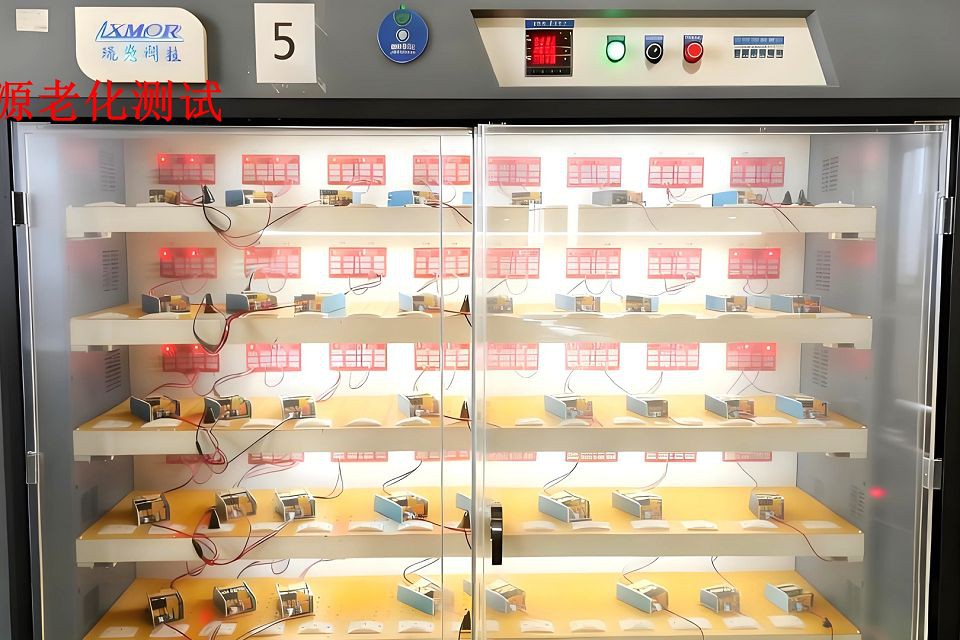
Phase 3: Extended Burn-In, Simulating Harsh Operating Conditions
Using dedicated burn-in racks, we subject 100% of products to extended full-load aging:
- Powered Burn-In: Units operate under powered, loaded, and elevated temperature conditions for several hours.
- Early Failure Screening: This process effectively precipitates and eliminates early-life failures caused by latent component defects, ensuring every shipped power supply has passed its "infant mortality" period and entered a stable performance state.
Phase 4: Secondary Core Performance Verification, 200-277VAC High-Line Input, 100% Full Inspection
All products undergo another 100% full inspection at the core electrical performance test station, which includes high-voltage insulation testers:
- Safety & Insulation: Critical safety tests including High-Potential (HI-POT) and insulation resistance tests are conducted to ensure compliance with safety standards, providing fundamental protection for end-users.

Phase 5: Stringent Final Release: Scientific Sampling-Based FQC
Prior to packaging and shipment, our Final Quality Control (FQC) is anything but perfunctory. We strictly adhere to the internationally recognized sampling inspection standard GB/T 2828.1-2012 (aligned with ISO 2859-1) for each production batch. A comprehensive set of performance and safety tests is performed on the drawn samples, with the Acceptable Quality Limit (AQL) serving as the core criterion for lot acceptance.

Phase 6: Reliability & Compliance, Dual Validation
Our independent Environmental and Electromagnetic Compatibility (EMC) Laboratory conducts sample-based verification for each batch to ensure compliance with safety certifications.
- Environmental Stress Testing: Inside temperature and humidity chambers, products are subjected to extreme conditions to evaluate long-term endurance and material stability.
- Electromagnetic Compatibility Testing: Within the EMC chamber, a full suite of tests including conducted emissions, radiated emissions, surge immunity, and electrostatic discharge (ESD) immunity is performed. This ensures the power supply exhibits strong noise immunity and does not cause electromagnetic interference to other devices, meeting the entry requirements of major global markets.


Phase 7: Quality Traceability & Continuous Improvement
Each power supply is marked with a unique serial number, enabling precise traceability of any quality issue and facilitating continuous optimization of production processes.